

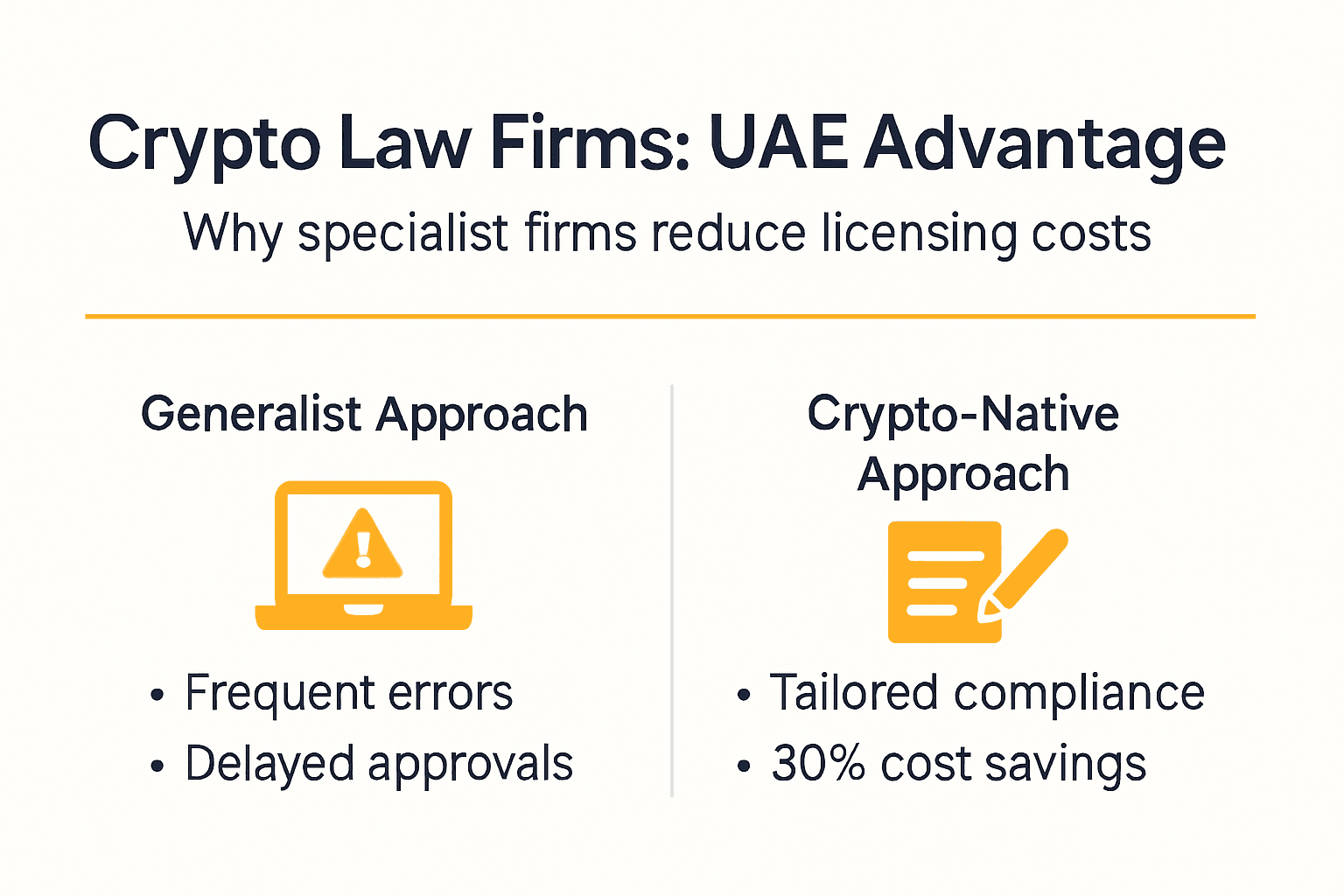
Crypto startups using specialised crypto-native law firms experience up to 30% faster licensing approvals in the UAE. Navigating the UAE’s multi-regulator environment demands precision. Five distinct regulatory bodies oversee digital assets, each with unique compliance frameworks. Founders and VASPs who engage specialist legal counsel gain technical blockchain expertise alongside regulatory fluency, dramatically reducing approval timelines. This guide reveals how crypto-native law firms accelerate licensing, mitigate compliance risks, and position startups for sustainable growth in 2026’s evolving landscape.
Table of Contents
- Introduction To Crypto-Native Law Firms
- Regulatory Landscape For Crypto Startups And VASPs In The UAE
- Technical Expertise: Why Blockchain Knowledge Matters In Legal Advice
- Tailored Compliance And Licensing Support From Crypto-Native Firms
- Common Misconceptions About Crypto Legal Advisory
- Multi-Jurisdictional Regulatory Support And Global Expansion
- How To Choose The Right Crypto-Native Law Firm
- Conclusion: Empowering Crypto Businesses With Specialised Legal Support
- Explore Expert Crypto Legal Services Tailored For Your UAE Startup
- Frequently Asked Questions
Key takeaways
| Point | Details |
|---|---|
| Crypto-native law firms combine blockchain technical knowledge with regulatory expertise | Specialised counsel understands both smart contract mechanics and compliance frameworks, enabling precise legal documentation |
| UAE crypto licensing requires navigating five distinct regulators with different criteria | VARA, SCA, DFSA, FSRA, and CBUAE each impose unique licensing requirements for VASPs |
| Tailored compliance frameworks reduce licensing failures by 40% compared to generic approaches | Custom policies aligned with specific regulator expectations accelerate approvals and minimise scrutiny |
| Multi-jurisdictional expertise supports expansion beyond UAE markets | Global regulatory knowledge across MiCA, MAS, and FCA frameworks enables seamless international scaling |
| Most general law firms lack the crypto specialisation needed for effective regulatory navigation | 70% of traditional firms lack specific crypto regulatory expertise, leading to costly delays |
Introduction to crypto-native law firms
Crypto-native law firms represent specialised legal practices focused exclusively on blockchain, digital assets, and Web3 regulation. Unlike traditional firms offering general corporate services, these practices employ lawyers who combine deep regulatory knowledge with genuine understanding of blockchain technology. They grasp consensus mechanisms, token economics, smart contract architecture, and decentralised governance structures. This dual expertise proves essential when drafting licence applications, compliance frameworks, and regulatory correspondence that must withstand technical scrutiny from sophisticated regulators.
General law firms typically treat crypto matters as extensions of securities law or corporate finance. 70% of general law firms lack specific crypto regulatory expertise, creating dangerous knowledge gaps. A lawyer unfamiliar with ERC-20 token standards cannot accurately advise on token classification. Someone without DeFi protocol experience struggles to structure compliant liquidity provision services. These deficiencies translate directly into licensing delays, compliance failures, and operational risks.
Crypto-native practices offer comprehensive services spanning the entire VASP lifecycle. Core offerings include pre-application regulatory strategy, licence preparation and submission, ongoing compliance advisory, AML/CTF policy design, corporate structuring for multi-entity operations, token issuance frameworks, and crypto escrow services in Dubai for secure settlements. Each service integrates technical blockchain understanding with regulatory precision.
Pro Tip: Before engaging any crypto law firm, request specific examples of their blockchain technical work. Ask them to explain concepts like layer-2 scaling solutions or liquidity pools. Their fluency reveals whether they truly understand the technology underpinning your business model.
Startups using generalist lawyers frequently face preventable setbacks. Applications get rejected for technical inaccuracies. Compliance frameworks fail to address regulator-specific requirements. Documentation uses imprecise terminology that raises red flags. These mistakes extend licensing timelines by months, drain budgets through resubmissions, and damage relationships with regulators before operations even begin.
Regulatory landscape for crypto startups and VASPs in the UAE
The UAE operates a complex multi-regulator structure for digital assets. Five distinct authorities govern crypto businesses: VARA oversees virtual assets in Dubai, SCA handles federal securities regulation, DFSA regulates the Dubai International Financial Centre, FSRA governs Abu Dhabi Global Market, and CBUAE sets monetary policy and payment services standards. Each regulator maintains separate licensing criteria, compliance expectations, and enforcement approaches.
VASP licensing requirements vary significantly across jurisdictions. VARA mandates comprehensive operational readiness assessments, capital adequacy proofs, and detailed governance frameworks before granting licences. DFSA and FSRA impose stringent financial crime controls and investor protection measures aligned with international standards. SCA focuses on securities classification and disclosure requirements for token offerings. Understanding which regulator governs your specific business model constitutes the first critical decision in your licensing journey.
Anti-money laundering and counter-terrorism financing obligations form the backbone of UAE crypto compliance. Regulators expect VASPs to implement transaction monitoring systems, customer due diligence processes, suspicious activity reporting mechanisms, and sanctions screening protocols. These requirements align with FATF recommendations and UAE Federal AML Law, creating rigorous standards that demand technical implementation expertise alongside legal compliance.
The overlapping jurisdictional landscape creates unique challenges:
- Businesses operating across multiple UAE jurisdictions may need licences from several regulators simultaneously
- Regulatory interpretations of similar activities can differ between VARA, DFSA, and FSRA frameworks
- Compliance policies must satisfy the most stringent requirements when operating in multiple zones
- Corporate structuring decisions determine which regulatory regime applies to specific business lines
Startups attempting to navigate this environment without expert guidance routinely encounter costly mistakes. They apply to the wrong regulator for their business model. They submit incomplete documentation missing critical compliance components. They underestimate capital requirements or operational readiness thresholds. Each error extends timelines and increases the risk of outright rejection. The UAE crypto regulatory landscape demands precision from day one, making specialised legal counsel not optional but essential. Payment service providers face additional complexity through UAE payments licensing requirements that intersect with VASP frameworks.
Technical expertise: why blockchain knowledge matters in legal advice
Legal accuracy in crypto matters requires genuine blockchain comprehension. Lawyers drafting licence applications must precisely describe technical operations. A VASP offering custody services needs documentation explaining private key management architecture, multi-signature protocols, and cold storage security measures. Advisors unfamiliar with these concepts produce vague descriptions that fail regulatory scrutiny. Technical fluency enables lawyers to translate complex blockchain operations into clear, compliant legal language that satisfies regulator information requirements.

Effective regulator communication depends on technical credibility. When authorities question operational procedures during licensing reviews, responses must demonstrate deep understanding. Lacking technical blockchain knowledge leads to misaligned legal documents and regulatory misunderstandings, increasing compliance risks substantially. Regulators recognise when lawyers truly grasp the technology versus when they parrot generic explanations. This credibility gap directly impacts approval likelihood and timeline.
The risks of engaging blockchain technical knowledge in legal advice deficient counsel extend beyond slow approvals. Misclassified activities trigger wrong regulatory frameworks. Smart contract vulnerabilities go unidentified in legal risk assessments. Token structures receive improper legal characterisations. Corporate governance frameworks fail to account for decentralised operations. Each gap creates potential compliance failures that surface during audits or enforcement actions.
Complex crypto concepts demand legal-tech fluency:
- Token standards like ERC-20, ERC-721, and ERC-1155 have distinct legal implications for classification and compliance
- Smart contract immutability affects liability frameworks and dispute resolution mechanisms
- Decentralised autonomous organisation structures challenge traditional corporate governance models
- Layer-2 scaling solutions introduce regulatory questions about where transactions occur and which jurisdiction applies
- DeFi protocols require analysis of whether intermediary roles trigger VASP licensing requirements
Pro Tip: During initial consultations, present your law firm with a technical challenge specific to your business model. Observe whether they engage confidently or deflect to generic regulatory discussion. Their response reveals true technical depth versus surface-level familiarity.
Lawyers who combine regulatory expertise with blockchain understanding deliver tangible value. They anticipate regulator questions before they arise. They structure operations to satisfy compliance requirements without sacrificing technical innovation. They communicate effectively with both your development team and regulatory authorities. This integration accelerates licensing, reduces risk, and positions your business for sustainable regulatory success.
Tailored compliance and licensing support from crypto-native firms
Custom compliance frameworks aligned with specific regulator expectations dramatically improve licensing outcomes. Crypto-native firms design policies matching each authority’s unique requirements. VARA demands detailed operational procedures and governance structures. DFSA emphasises financial crime controls and client asset protection. FSRA focuses on market conduct and disclosure standards. Generic compliance templates fail to address these jurisdiction-specific nuances, triggering requests for substantial revisions that extend timelines.
Tailored compliance frameworks reduce licensing failures by 40% compared to generic setups. This improvement stems from precision alignment between business operations and regulatory expectations. Specialised firms integrate AML/CTF policies reflecting FATF standards and UAE Federal AML Law requirements. They design transaction monitoring calibrated to your specific risk profile. They craft governance structures satisfying regulator preferences for oversight and accountability.
| Aspect | Tailored Compliance | Generic Compliance |
|---|---|---|
| Licensing Success Rate | 85-90% first submission approval | 45-50% first submission approval |
| Average Timeline | 3-5 months to full licence | 6-12 months with resubmissions |
| Regulatory Scrutiny | Minimal follow-up questions | Extensive clarification requests |
| Long-term Audit Risk | Low, policies align with expectations | Moderate to high, gaps surface later |
| Operational Flexibility | Frameworks enable growth | Rigid structures limit adaptation |
Crypto-native firms follow systematic licensing preparation processes:
- Early engagement assessment evaluates your business model, target markets, and regulatory options to identify optimal jurisdiction and licensing strategy
- Regulator mapping determines which UAE authority governs your activities and documents specific compliance requirements for that framework
- Tailored policy drafting creates bespoke AML/CTF procedures, risk management frameworks, governance structures, and operational manuals aligned with regulator expectations
- Comprehensive documentation preparation assembles application materials, financial projections, technical architecture descriptions, and compliance evidence meeting submission standards
- Ongoing support throughout review provides rapid response to regulator queries, coordinates additional information requests, and manages relationship through approval
These structured approaches deliver measurable benefits. Regulators spend less time scrutinising applications because documentation anticipates their questions. First submission approval rates increase substantially. Post-licence audit findings decrease because policies genuinely reflect operational reality rather than copied templates. Businesses gain confidence that compliance frameworks will withstand regulatory examination.
Dubai crypto regulatory compliance demands particular attention to VARA’s evolving standards. ADGM crypto compliance requires alignment with FSRA’s financial services focus. Effective AML/CTF policy design must satisfy both international standards and local regulatory interpretation. Crypto-native firms navigate these complexities daily, translating regulatory requirements into practical operational frameworks that enable business growth while maintaining compliance integrity.
Common misconceptions about crypto legal advisory
Myth 1: Any lawyer can handle crypto regulations effectively. Reality: Crypto regulation sits at the intersection of financial services law, technology law, securities regulation, and emerging digital asset frameworks. 70% of general law firms lack specific crypto regulatory expertise, creating dangerous knowledge gaps. Generalist lawyers miss technical nuances, misclassify activities, and produce compliance frameworks that fail regulatory scrutiny. The specialisation gap is not trivial; it determines whether your licence application succeeds or fails.
Myth 2: Crypto regulation is consistent globally. Reality: Regulatory approaches vary dramatically across jurisdictions. The EU’s MiCA framework imposes comprehensive authorisation and operational requirements. Singapore’s MAS takes a principles-based approach emphasising financial stability. The UK’s FCA focuses on consumer protection and financial crime prevention. Each regime defines VASPs differently, applies distinct licensing thresholds, and enforces unique compliance standards. Assuming global consistency leads to costly compliance failures when expanding internationally.
Myth 3: Legal advice for crypto is one-size-fits-all. Reality: Effective crypto legal advisory must align precisely with your business model, target markets, and growth strategy. An exchange faces different regulatory requirements than a custody provider. A stablecoin issuer navigates distinct frameworks from a DeFi protocol. Payment service providers encounter separate licensing regimes. Generic advice ignoring these distinctions produces misaligned compliance structures that either over-regulate simple activities or under-protect high-risk operations.
These misconceptions generate predictable consequences:
- Startups waste months pursuing licences from inappropriate regulators based on flawed advice
- Compliance frameworks contain gaps that surface during regulatory examinations, triggering enforcement actions
- International expansion strategies fail because lawyers lack multi-jurisdictional expertise
- Operational structures prove incompatible with regulatory requirements, forcing costly restructuring
- Capital gets trapped in licensing delays while competitors gain market position
The correction to each myth is straightforward. Engage lawyers with proven crypto regulatory expertise and technical blockchain knowledge. Recognise that regulatory strategy must account for jurisdictional differences and business-specific factors. Invest in tailored legal advisory that aligns with your actual operations and growth ambitions. The cost differential between specialist and generalist counsel pales compared to the expense of licensing failures, compliance violations, and missed market opportunities.
Multi-jurisdictional regulatory support and global expansion
Successful crypto businesses increasingly operate across multiple jurisdictions. The EU’s MiCA regulation creates harmonised rules for crypto-asset service providers across 27 member states. Singapore’s MAS framework attracts Asian expansion through clear licensing pathways and progressive regulatory dialogue. The UK’s FCA regime offers access to major financial markets with established regulatory infrastructure. Each framework presents distinct opportunities and compliance obligations.
Crypto-native law firms support regulatory alignment across more than 30 crypto-friendly jurisdictions globally. This breadth enables startups to plan international expansion from inception rather than retrofitting compliance after establishing UAE operations. Firms with global networks coordinate licensing across multiple markets simultaneously, ensuring corporate structures and compliance frameworks satisfy requirements in each target jurisdiction.
Investor confidence depends on regulatory credibility. Institutional capital flows to businesses demonstrating robust compliance across relevant jurisdictions. Family offices evaluate regulatory standing before allocating to crypto ventures. Traditional financial institutions entering Web3 demand partners with established regulatory track records. Multi-jurisdictional legal support provides evidence of compliance maturity that attracts sophisticated capital.
Key international regulatory frameworks and services:
- MiCA compliance for EU market access, including authorisation processes and ongoing regulatory reporting
- MAS licensing in Singapore covering payment services, capital markets products, and digital payment tokens
- FCA registration in the UK for crypto-asset businesses and electronic money institutions
- FINTRAC compliance in Canada for money services businesses handling virtual currencies
- Coordination across Gulf Cooperation Council markets for regional expansion strategies
Startups planning regional or global scaling need legal partners who understand regulatory interdependencies. Licensing decisions in one jurisdiction affect options in others. Corporate structures must accommodate multiple regulatory regimes without creating conflicts. Compliance frameworks should leverage common standards like FATF recommendations while addressing jurisdiction-specific requirements. Multi-jurisdictional legal expertise transforms these complexities into strategic advantages.
Regulatory landscapes evolve rapidly. VARA enforcement insights from 2026 reveal shifting priorities and interpretation. Staying current with latest crypto regulatory updates across multiple markets requires dedicated monitoring and analysis. Crypto-native firms with global presence track regulatory developments, assess implications for client operations, and proactively adjust compliance strategies. This forward-looking approach prevents surprises and positions businesses to capitalise on new regulatory opportunities as they emerge.
How to choose the right crypto-native law firm
Selecting legal counsel determines your regulatory trajectory. Proven crypto regulatory expertise forms the foundation. Examine the firm’s track record with VASP licensing across UAE regulators. Request case studies demonstrating successful applications and compliance framework implementations. Verify technical blockchain knowledge through substantive discussion of your specific business model. Surface-level familiarity becomes obvious when you probe technical details.
Experience navigating the UAE’s multi-regulator environment matters enormously. Firms should demonstrate fluency with VARA, SCA, DFSA, FSRA, and CBUAE requirements. They should articulate how licensing strategies differ across jurisdictions and why certain regulatory choices suit particular business models. Success rates provide objective evidence; firms achieving 85%+ first submission approvals possess genuine expertise.
Multi-jurisdictional capability enables growth beyond UAE markets. Evaluate the firm’s international network and experience with frameworks like MiCA, MAS, and FCA. Ask about coordination mechanisms for simultaneous licensing across markets. Confirm they maintain relationships with regulators in target expansion jurisdictions. Global reach combined with local UAE expertise positions you for scalable international operations.
Value-added services distinguish exceptional firms from competent ones. Crypto escrow provision demonstrates operational capability beyond pure legal advice. Tokenisation structuring expertise enables innovative business models. Corporate restructuring services support evolving regulatory strategies as your business grows. These integrated offerings streamline execution and reduce the need for multiple specialist providers.
Pro Tip: Request detailed client references and speak directly with founders who have completed licensing processes with the firm. Ask about responsiveness during regulatory reviews, accuracy of timeline predictions, and value delivered relative to fees. Peer insights reveal operational realities that marketing materials obscure.
Key questions for evaluating potential legal advisors:
- How many VASP licences have you successfully obtained across UAE regulators in the past 24 months?
- Can you explain the technical architecture of our business model and identify potential regulatory classification issues?
- What is your average timeline from engagement to licence approval for businesses similar to ours?
- How do you coordinate multi-jurisdictional compliance for clients expanding internationally?
- What ongoing compliance support do you provide post-licence to ensure sustained regulatory standing?
- Can you provide references from crypto businesses at similar growth stages to ours?
The right crypto-native law firm becomes a strategic partner, not just a service provider. They understand your technology, speak your language, and share your growth ambitions. They translate regulatory complexity into actionable strategy. They position compliance as an enabler rather than an obstacle. This partnership approach accelerates licensing, mitigates risk, and builds the regulatory foundation for sustainable success.
Conclusion: empowering crypto businesses with specialised legal support
Specialised legal support transforms regulatory compliance from obstacle to competitive advantage. Crypto-native law firms combine technical blockchain expertise with deep regulatory knowledge, enabling precise licence applications and robust compliance frameworks. Their multi-jurisdictional experience positions startups for international expansion while their tailored advisory reduces approval timelines by up to 30%. These benefits translate directly into faster market entry, reduced compliance risk, and enhanced investor confidence.
The UAE’s complex regulatory landscape demands precision. Five distinct regulators impose unique requirements. Generic legal advice produces costly failures whilst specialist counsel delivers measurable results. Firms achieving 40% lower licensing failure rates through tailored compliance demonstrate the value of expertise. Technical fluency enables effective regulator communication. Global networks support scalable growth beyond local markets.
Choosing the right legal partner determines your regulatory trajectory. Proven track records, technical competence, multi-jurisdictional capability, and value-added services distinguish exceptional firms. The investment in specialist counsel pays dividends through accelerated approvals, operational stability, and sustainable compliance. In 2026’s evolving digital assets landscape, crypto-native legal expertise is not optional for ambitious startups and VASPs. It is the foundation for regulatory success and long-term market leadership.
Explore expert crypto legal services tailored for your UAE startup
Navigating UAE crypto regulations demands specialised expertise combining technical blockchain knowledge with regulatory precision. Our firm guides startups and VASPs through VASP licensing across all five UAE regulators whilst designing compliance frameworks that accelerate approvals and mitigate risk. From pre-application strategy to post-licence ongoing support, we deliver regulator-ready solutions that withstand scrutiny.
Whether you are launching an exchange, structuring a token offering, or expanding internationally, our crypto-native legal team provides the expertise you need. Explore our comprehensive guidance on Dubai virtual asset regulations, review our detailed Dubai crypto compliance guide, or discover how our crypto startup legal consultancy accelerates your path to regulatory approval and sustainable growth.
Frequently asked questions
What makes a law firm ‘crypto-native’ compared to traditional firms?
Crypto-native firms employ lawyers who combine genuine blockchain technical understanding with regulatory expertise. They grasp token economics, smart contract architecture, and consensus mechanisms, enabling precise legal documentation that satisfies technical regulator scrutiny. Traditional firms treat crypto as an extension of general corporate law, lacking the specialised knowledge needed for effective VASP licensing and compliance advisory.
How early should a crypto startup engage a specialised law firm for licensing?
Engage crypto-native legal counsel during your initial business planning phase, ideally 6-9 months before target launch. Early involvement enables optimal regulatory strategy, proper corporate structuring, and compliance framework design from inception. Late engagement forces costly retrofitting and extends licensing timelines as you correct structural issues that proactive planning would have prevented.
Are crypto-native law firms expensive compared to general legal services?
Specialist firms typically charge premium rates reflecting their expertise, but deliver superior value through faster approvals and lower failure rates. Generic legal advice appearing cheaper initially generates hidden costs through licensing delays, resubmissions, and compliance gaps. The 30% timeline reduction and 40% lower failure rate achieved by crypto-native firms translates into substantial savings and faster revenue generation.
Can one crypto-native law firm handle multi-jurisdictional compliance?
Leading crypto-native firms maintain global networks enabling coordinated compliance across 30+ jurisdictions. They manage simultaneous licensing in the UAE whilst preparing for expansion into EU MiCA markets, Singapore MAS frameworks, and UK FCA regimes. This integrated approach ensures corporate structures and compliance policies satisfy requirements across all target markets, avoiding conflicts that emerge from fragmented legal advisory. Review UAE crypto regulations for comprehensive jurisdiction guidance.
What are typical turnaround times for VASP licensing when using experts?
With crypto-native legal support, expect 3-5 months from application submission to licence approval for straightforward VASP models. Complex businesses offering multiple services or operating across jurisdictions may require 6-8 months. These timelines assume proper preparation, complete documentation, and responsive engagement during regulatory review. Generic legal counsel typically extends timelines to 9-12 months through incomplete submissions and multiple revision cycles.