

Dubai’s crypto regulatory landscape features five distinct authorities, and many entrepreneurs struggle to identify which regulator governs their operations. The Dubai Financial Services Authority (DFSA) oversees digital asset activities exclusively within the Dubai International Financial Centre (DIFC), applying a framework distinct from other Dubai regulators. This article clarifies the DFSA’s updated 2026 regulatory approach, explains how recent reforms shift compliance responsibilities to firms, and provides practical guidance for crypto businesses navigating DIFC’s regulatory environment.
Key takeaways
| Point | Details |
|---|---|
| DFSA’s DIFC mandate | The DFSA regulates financial services including crypto tokens exclusively within the Dubai International Financial Centre, separate from other Dubai jurisdictions. |
| 2026 suitability reforms | Authorised firms now independently assess crypto token suitability using five defined criteria, replacing the previous DFSA recognised token approach. |
| Enhanced governance standards | Updated framework strengthens conduct obligations, prudential requirements, custody safeguards, and financial crime controls for crypto operations. |
| Jurisdictional clarity | DFSA governs DIFC activities whilst VARA regulates virtual assets elsewhere in Dubai, requiring firms to understand which authority applies. |
| Compliance documentation | Firms must maintain thorough records justifying token assessments, governance structures, and ongoing risk management aligned with DFSA standards. |
The DFSA’s regulatory mandate in the Dubai International Financial Centre
The DFSA operates as the independent financial services regulator for the Dubai International Financial Centre, supervising a comprehensive range of activities beyond just crypto assets. Its mandate encompasses banking operations, asset management, Islamic finance, securities trading, and commodities derivatives, creating an integrated regulatory framework where digital assets fit alongside traditional financial services. This broad scope means crypto firms operating in DIFC face the same rigorous standards applied to established financial institutions.
The authority supervises authorised firms, registered auditors, and market infrastructure institutions conducting business within DIFC’s jurisdiction. For crypto businesses, this translates to regulatory oversight when managing collective investment funds holding digital assets, providing trust services involving tokens, or trading commodity derivatives linked to cryptocurrencies. Understanding this integrated approach reveals why DFSA regulatory oversight differs fundamentally from standalone virtual asset frameworks.
Crypto tokens are classified within the DFSA’s existing financial service categories rather than treated as an entirely separate asset class. This integration means firms benefit from established regulatory principles whilst adapting to digital asset specific requirements. The framework recognises that crypto activities often intersect with traditional financial services, requiring consistent standards across both domains.
Key aspects of the DFSA’s crypto regulatory scope include:
- Authorisation requirements for firms conducting specified crypto activities within DIFC
- Ongoing supervision ensuring compliance with conduct, prudential, and governance standards
- Market infrastructure oversight for platforms facilitating crypto trading or custody
- Enforcement powers addressing regulatory breaches or market misconduct
- Policy development adapting regulations to emerging crypto market developments
This comprehensive mandate positions the DFSA as a sophisticated regulator capable of addressing complex crypto business models. Firms choosing DIFC benefit from regulatory clarity backed by established legal frameworks, yet must meet demanding compliance standards that reflect the authority’s institutional approach. Understanding crypto regulations in DIFC requires recognising how digital assets integrate into this broader financial services ecosystem.
Key 2026 reforms in DFSA’s crypto token regulation
The 2026 regulatory updates represent a fundamental shift in how the DFSA approaches crypto token oversight. Previously, the authority maintained recognised token lists that firms could reference when determining which assets fell within regulatory scope. The reformed framework transfers suitability assessment responsibility entirely to authorised firms, requiring them to independently evaluate tokens using five specific criteria before offering services involving those assets.
Firms must now assess each crypto token across these dimensions:
- Compliance compatibility examining whether the token’s design and operation align with applicable regulatory requirements
- Technology resilience evaluating the underlying blockchain infrastructure, security protocols, and operational stability
- Market size and liquidity analysing trading volumes, market depth, and price stability indicators
- International regulatory status reviewing how other jurisdictions classify and regulate the specific token
- Token governance assessing the decision making structures, transparency standards, and accountability mechanisms governing the token’s ecosystem
This criteria based approach demands sophisticated internal capabilities. Firms cannot simply reference external lists but must develop expertise to evaluate tokens independently. The shift reflects the DFSA’s recognition that crypto markets evolve too rapidly for static recognised token lists to remain relevant, and that firms closest to the assets should bear responsibility for suitability determinations.
Enhanced safeguards accompany this responsibility transfer. The updated framework strengthens conduct standards governing client interactions, ensuring firms provide appropriate disclosures and manage conflicts of interest. Prudential obligations now explicitly address crypto specific risks, requiring capital buffers reflecting digital asset volatility. Custody requirements mandate robust safeguards for client crypto holdings, including segregation protocols and insurance considerations. Financial crime controls integrate crypto specific AML and CFT measures aligned with FATF guidance.
The framework merges crypto regulation seamlessly into existing DFSA rules rather than creating parallel requirements. This integration means firms apply familiar regulatory principles whilst addressing digital asset nuances. For example, conduct standards developed for traditional securities now extend to crypto tokens, adapted for blockchain specific characteristics.
Pro Tip: Firms should establish cross functional teams combining legal, compliance, technology, and risk expertise when conducting token suitability assessments, as the five criteria span multiple disciplines requiring integrated evaluation.
The table below summarises the five suitability criteria and key evaluation factors:
| Criterion | Key evaluation factors |
|---|---|
| Compliance compatibility | Regulatory classification, legal status, jurisdictional restrictions, sanctions screening |
| Technology resilience | Blockchain security, consensus mechanism stability, smart contract audits, operational uptime |
| Market size and liquidity | Trading volumes, order book depth, price volatility, exchange availability |
| International regulatory status | Classifications by major regulators, cross border restrictions, regulatory actions or warnings |
| Token governance | Development team transparency, decision making processes, community governance structures |
These reforms position DFSA compliance as a dynamic, firm driven process rather than a checklist exercise. Businesses must invest in ongoing monitoring capabilities as token characteristics evolve, requiring regular reassessment against the five criteria. The framework acknowledges that suitable tokens today may become unsuitable tomorrow based on technology failures, regulatory developments, or governance breakdowns. Understanding DFSA fees and capital rules becomes essential as prudential requirements now explicitly factor in crypto exposure.
Practical implications for crypto firms under DFSA regulation
Implementing the 2026 framework demands significant operational adjustments for crypto firms in DIFC. Documented rationale for token suitability assessments becomes the foundation of compliance, requiring firms to maintain detailed records explaining how each token meets the five criteria. This documentation must withstand regulatory scrutiny, demonstrating rigorous analysis rather than superficial review. Ongoing oversight mechanisms ensure assessments remain current as market conditions change.

Enhanced internal governance structures prove essential for meeting the framework’s demands. Firms must designate clear accountability for token assessment decisions, ensuring senior management oversight and appropriate expertise involvement. Governance frameworks should establish approval processes for adding new tokens, periodic review cycles for existing holdings, and escalation procedures when suitability concerns emerge. The DFSA expects governance quality comparable to traditional asset management operations.
Risk management extends across multiple dimensions under the updated regime. Operational resilience requirements address technology failures, cyber threats, and business continuity scenarios specific to crypto operations. AML and CFT controls must reflect digital asset specific risks including mixing services, decentralised exchanges, and cross chain transactions. Capital adequacy calculations now explicitly incorporate crypto volatility, requiring buffers that adjust dynamically as portfolio composition changes.
Regular policy and control reviews become mandatory rather than optional. The DFSA expects firms to assess their frameworks at least annually, updating procedures to reflect regulatory developments, market evolution, and internal experience. Reviews should examine whether suitability criteria remain appropriate, governance structures function effectively, and risk controls address emerging threats. Documentation of these reviews demonstrates ongoing compliance commitment.
Essential compliance steps firms must implement include:
- Developing comprehensive token assessment frameworks incorporating all five suitability criteria with documented evaluation methodologies
- Establishing governance committees with clear mandates, appropriate expertise, and senior management representation
- Implementing ongoing monitoring systems tracking token performance, regulatory developments, and governance changes
- Creating detailed record keeping procedures capturing assessment rationale, approval decisions, and review outcomes
- Training staff across relevant functions on crypto specific risks, regulatory requirements, and internal procedures
- Engaging external expertise where internal capabilities require supplementation, particularly for complex technical assessments
Pro Tip: Avoid relying on previous DFSA recognised token lists as compliance shortcuts; the 2026 reforms explicitly require independent firm assessment regardless of prior regulatory classifications.
The framework recognises that different firms may reach different conclusions about the same token based on their specific business models, client bases, and risk appetites:
A token deemed suitable for a sophisticated institutional investor platform may prove unsuitable for a retail focused exchange, reflecting different risk profiles and client protection considerations inherent to each business model.
This principle underscores that suitability assessments are firm specific exercises requiring contextual analysis. Compliance cannot be outsourced through third party assessments or industry consensus; each firm bears responsibility for determinations aligned with its operations. Understanding safe custody compliance becomes critical as custody obligations now demand explicit consideration of token specific risks.
The crypto licence application process for DIFC now requires applicants to demonstrate capability to conduct independent token assessments before authorisation. Prospective firms must present governance frameworks, assessment methodologies, and resource commitments proving they can meet the 2026 standards from day one. This raises the bar for market entry whilst ensuring only adequately prepared businesses receive authorisation.
DFSA’s role within Dubai’s broader crypto regulatory landscape
The DFSA’s jurisdiction remains strictly limited to the Dubai International Financial Centre, creating clear boundaries within Dubai’s multi regulator environment. Virtual asset activities outside DIFC fall under the Virtual Assets Regulatory Authority (VARA), which governs crypto operations throughout Dubai emirate excluding the financial free zone. This jurisdictional division requires crypto businesses to understand precisely where their activities occur and which regulatory framework applies.
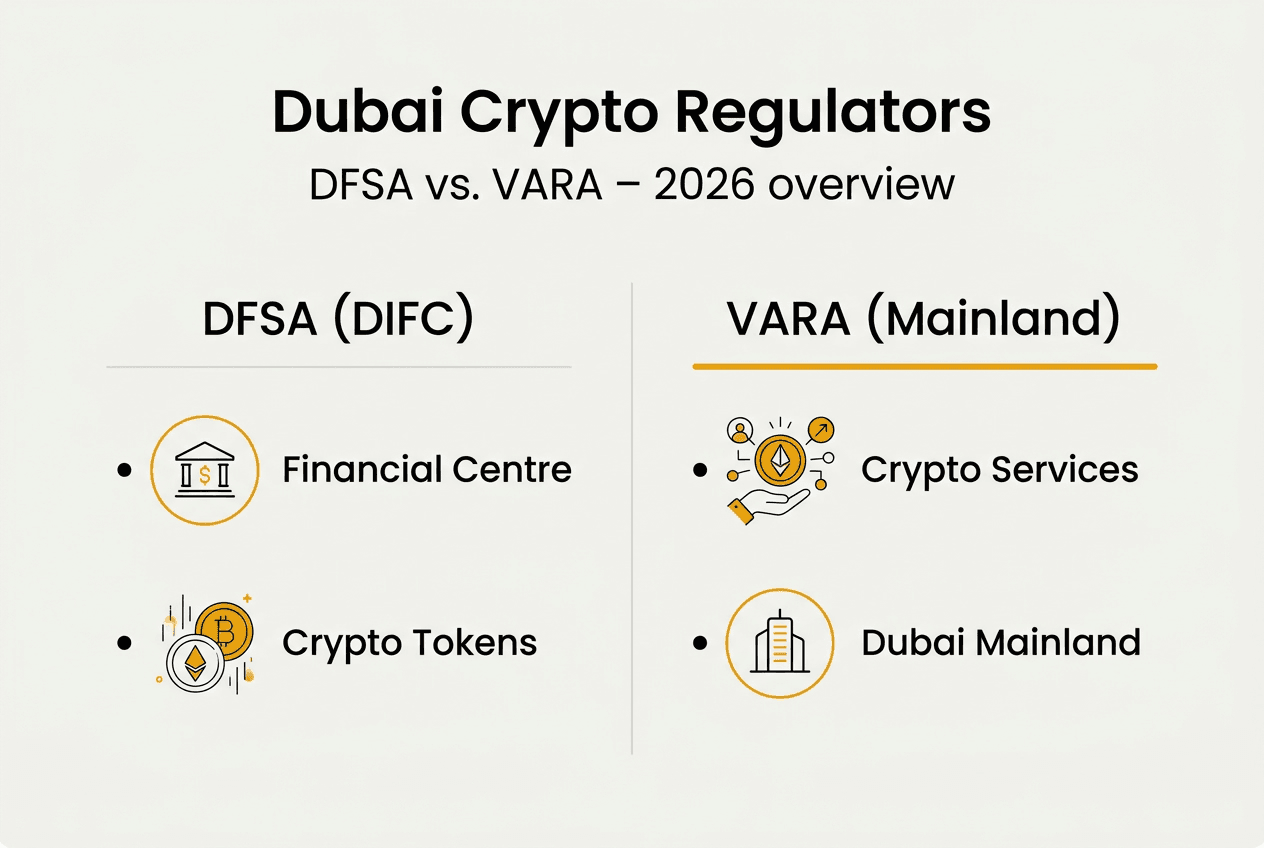
VARA and DFSA operate distinct regulatory philosophies reflecting their different mandates. VARA focuses exclusively on virtual assets, developing specialised rules addressing crypto specific risks and business models. The DFSA integrates crypto regulation into broader financial services oversight, applying institutional standards developed across multiple asset classes. Neither approach is inherently superior; they serve different market segments and operational models.
The comparison table below highlights key distinctions:
| Aspect | DFSA (DIFC) | VARA (Dubai mainland) |
|---|---|---|
| Jurisdictional scope | Dubai International Financial Centre only | Dubai emirate excluding DIFC |
| Regulatory approach | Integrated financial services framework | Dedicated virtual asset regime |
| Target market | Institutional and sophisticated investors | Broader market including retail |
| Licensing categories | Financial service permissions adapted for crypto | Virtual asset specific licence types |
| Governance standards | Institutional financial services requirements | Crypto tailored governance frameworks |
Firms must determine their regulatory path based on operational location and target clientele. Businesses serving institutional investors within DIFC naturally fall under DFSA oversight, benefiting from the centre’s established legal infrastructure and international recognition. Companies targeting broader retail markets or operating from Dubai mainland locations require VARA licensing, navigating that authority’s distinct requirements.
Key coordination and distinction points include:
- Physical location determines primary jurisdiction, with DIFC boundaries defining DFSA versus VARA applicability
- Marketing and client acquisition activities outside DIFC may trigger VARA requirements even for DIFC licensed firms
- Cross border operations require consideration of both frameworks when serving clients across jurisdictions
- Regulatory arbitrage attempts face scrutiny, with authorities coordinating to prevent circumvention through jurisdiction shopping
- Some firms may require dual licensing if operations genuinely span both jurisdictions, though this adds significant compliance complexity
Understanding the Dubai crypto regulatory comparison proves essential for strategic planning. Businesses must evaluate which framework aligns with their target market, operational model, and growth strategy before committing to a regulatory path. The choice carries long term implications for compliance costs, market access, and operational flexibility.
DFSA supervises authorised firms in DIFC through periodic inspections, ongoing reporting requirements, and thematic reviews examining industry wide issues. This supervision intensity reflects institutional standards applied across DIFC’s financial services sector. VARA employs different supervisory approaches tailored to virtual asset specific risks, including technology audits and blockchain analytics.
The jurisdictional clarity emerging from this framework benefits the broader ecosystem. Firms gain certainty about applicable requirements, regulators avoid overlap and conflict, and clients understand which protections govern their transactions. However, businesses must invest effort understanding these distinctions rather than assuming a one size fits all approach to Dubai crypto regulation. Exploring VARA regulations overview alongside DFSA requirements provides comprehensive perspective on available regulatory pathways.
Get expert guidance for compliant crypto operations in Dubai
Navigating the DFSA’s 2026 framework demands specialised legal expertise combining regulatory knowledge with practical crypto industry understanding. CRYPTOVERSE Legal Consultancy provides comprehensive support for businesses operating under DFSA oversight in DIFC or evaluating which Dubai regulatory path aligns with their operations. Our team advises on token suitability assessments, governance framework design, and ongoing compliance management tailored to your specific business model.

Whether you’re launching a new crypto venture, expanding existing operations into DIFC, or ensuring current practices meet updated standards, professional guidance mitigates regulatory risk whilst supporting sustainable growth. Our digital asset legal consultant services span the full regulatory lifecycle from initial licensing through operational compliance. We also provide comparative analysis between VARA regulations and licensing and DFSA requirements, helping you select the optimal regulatory pathway. Early engagement with our DFSA compliance guide for founders ensures your business builds compliance into operational foundations rather than retrofitting requirements later.
FAQ
What is the Dubai Financial Services Authority (DFSA)?
The DFSA serves as the independent financial regulator for the Dubai International Financial Centre, overseeing banking, asset management, securities, commodities, and crypto token activities within DIFC’s jurisdiction. It ensures financial stability, investor protection, and compliance with international regulatory standards through comprehensive supervision of authorised firms and market infrastructure.
How do the 2026 DFSA crypto reforms affect my firm?
Firms now bear responsibility for independently assessing crypto token suitability using five defined criteria covering compliance, technology, liquidity, international status, and governance. You must document assessment rationale, establish robust governance structures, and implement enhanced risk management addressing crypto specific operational, financial crime, and prudential considerations.
What is the difference between DFSA and VARA when regulating crypto?
The DFSA regulates crypto activities exclusively within the Dubai International Financial Centre, integrating digital assets into broader financial services oversight with institutional standards. VARA governs virtual asset operations throughout Dubai emirate outside DIFC, applying dedicated crypto specific regulations. Your physical location and target market determine which authority regulates your business.
What are the five criteria for token suitability assessments?
Firms must evaluate compliance compatibility with regulatory requirements, technology resilience of blockchain infrastructure, market size and liquidity indicators, international regulatory status across jurisdictions, and token governance structures. Each criterion requires documented analysis demonstrating thorough evaluation rather than superficial review.
Can I operate under both DFSA and VARA simultaneously?
Whilst theoretically possible if operations genuinely span both jurisdictions, dual licensing adds significant compliance complexity and cost. Most firms benefit from selecting one regulatory pathway aligned with their primary operations and target market. Cross jurisdictional marketing or client acquisition may trigger additional requirements even with single licensing.